
Chain Operations
Teishoku Set Composition: Building the Set-Meal Table
The Japanese set meal is a complete table delivered at once — rice, soup, three dishes, each on its correct vessel. How chains compose the teishoku kit and keep it identical across stores.
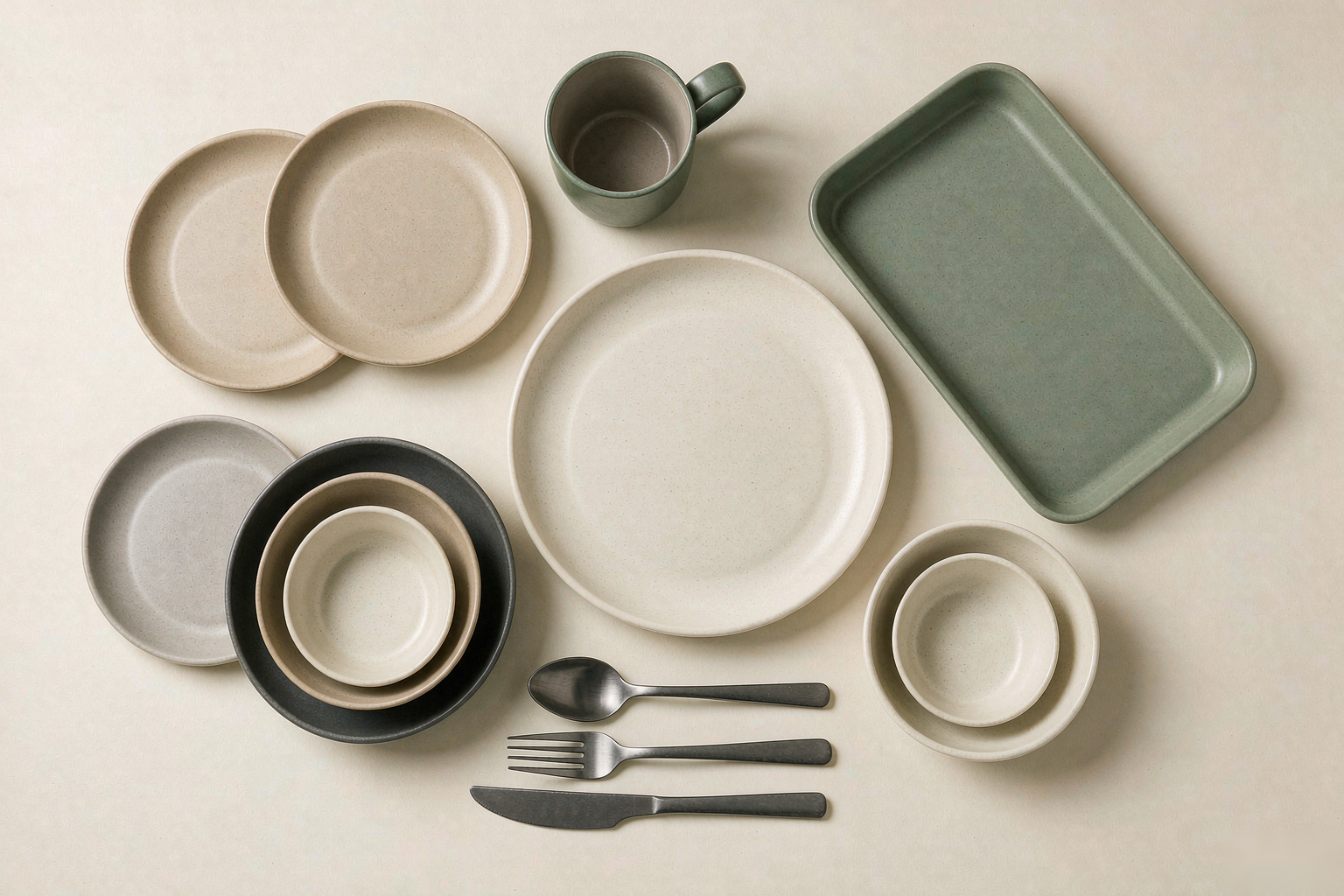
The teishoku arrives all at once: rice at the guest's left, soup at the right, three dishes arranged behind, pickles beside, on a table geometry fixed by centuries of habit. Where Western service paces courses, the Japanese set meal delivers the complete table in a single composition — and the tableware is the composition. There is nowhere for a mismatched bowl or a wrong-shaped dish to hide.
For chains serving set meals — from Japanese teishoku to Korean dosirak-style sets and Asian fast-casual interpretations — the set is a kit: a defined vessel list, a fixed arrangement, and a consistency contract across every store. This guide covers building the kit.
The Canonical Composition
The reference teishoku (one soup, three dishes, plus rice and pickles) translates directly into a vessel manifest:
Position | Vessel | Format notes |
|---|---|---|
Guest's left | Rice bowl, lidded option | The anchor; held in the hand |
Guest's right | Soup bowl, lidded option | The wan; lifted and drunk |
Upper center | Main plate or hachi | The protein course's stage |
Upper sides | Two side dishes (kozara) | The composed miniatures |
Beside rice | Pickle dish (kotsubo) | Small, often the accent piece |
Set periphery | Chopsticks + rest, tray | The frame that unifies |
Two structural notes for chains: first, the tray is what makes a set a set — a single carrying and presentation surface that delivers the composition in one motion. Tray geometry (our trays guide covers the format) sets the footprint every vessel must fit. Second, the lids are the set-meal's signature moment: lifting a lidded soup bowl is the format's theatre, and lids double the piece count and the matching burden of the bowl family.
The Kit Logic
Compose the set as a kit, not as pieces:
Fixed manifest. The vessel list above, with capacities and shapes defined per class. The kit approach keeps the dish room honest — every set breaks down to the same pieces, washes in the same racks, and reassembles without interpretation. A set that varies by store is not a set; it is a coincidence.
The ratio rule. Multiply the manifest by the par arithmetic (our par-level guide) with set-thinking: one set's vessels travel together through the loop, so par units are sets-per-turn, not pieces-per-seat. The math is simpler and the stockouts are structural — when sets run short, every vessel runs short together, which the kitchen sees coming.
The family discipline. Every vessel in the set belongs to one or two approved families (our vessel map defines the classes): same glaze palette, same finish tier, same batch-verification discipline. The izakaya library's mixing-with-discipline applies inside the set too — deliberate variety across the dishes, unified by palette and finish.
The Arrangement Contract
The composition's geometry is part of the product. Guests who know the format read arrangement errors instantly; guests who don't still feel the balance:
Rice left, soup right — the canonical placement, violated only deliberately (some regional traditions invert; a chain standardizes on one and writes it into the service manual).
The main's stage — the largest vessel carries the visual center behind the rice-soup pair; the kozara flank it in balanced asymmetry, the aesthetic our small-plate library describes.
The frame — chopsticks on the rest, parallel to the guest's edge; the tray's rim as the composition's boundary. The tray makes the frame literal.
For multi-store consistency, the arrangement belongs in the photo standard: the approved full-set photograph travels with the specification book, and the mystery-shop check compares tables to the photo — the same discipline that holds plating standards across chains worldwide.
Lids, Trays and the Economics of Theatre
The set-meal's premium markers — lidded bowls, the delivered tray — carry real operational weight:
Lids. They hold heat through the carry, present the lift-the-lid moment, and add a full lid fleet to the manifest (lids wash separately, warp their own way, and vanish their own way — par them like small pieces on the loss log). Lidded service suits full-service and premium tiers; quick-casual runs open bowls and keeps the theatre budget for elsewhere.
Trays. The tray is simultaneously presentation (the frame), equipment (the carry), and dishwasher reality (a big flat piece with its own rack demands). Tray material follows the melamine-versus-wood-versus-metal logic our program guides cover; the set concept usually lands on engineered melamine or lacquer-look composites for exactly the reasons volume concepts always do.
The one-motion service. The set's operational promise is speed: one tray, one delivery, complete table. The kit that holds together — vessels that nest on the tray, lids that seat, pieces that carry as a unit — makes the promise; a loose kit of mismatched pieces turns every delivery into an assembly project at the table.
Frequently Asked Questions
Does every set meal need the full one-soup-three-dishes structure? The structure scales down — set concepts run two-dish and one-dish variants — but the vessel manifest shrinks by the same lines every time, and the arrangement logic holds at every size.
Why tray service instead of placing each piece? The tray is the set's delivery mechanism and its frame. Placing pieces individually trades the one-motion service for time, and the composition for improvisation.
How do we keep sets identical across dozens of stores? The photo standard plus the sealed references plus SKU-marked vessels — the same fleet discipline that holds every other program, applied to a composition where a single wrong bowl is visible at a glance.
Lidded or open bowls for a mid-market concept? Lids where the lift-the-lid moment is part of the price justification; open where speed and simplicity carry the concept. The lid decision is a brand decision expressed as a par count.
What breaks teishoku programs most often? Piece drift — the set's bowls replaced piecemeal by near-matches until no two tables match. The kit manifest with batch-verified replacements is the countermeasure.


