
Oct 29, 2026Chain Operations
Serving Trays for Chain Restaurants: The Lowest-MOQ Entry into a Tableware Program
Trays take the most daily abuse and carry the lowest MOQ in a tableware range. Why a 200-piece tray order is the cheapest way to test a supplier before the main plate order.
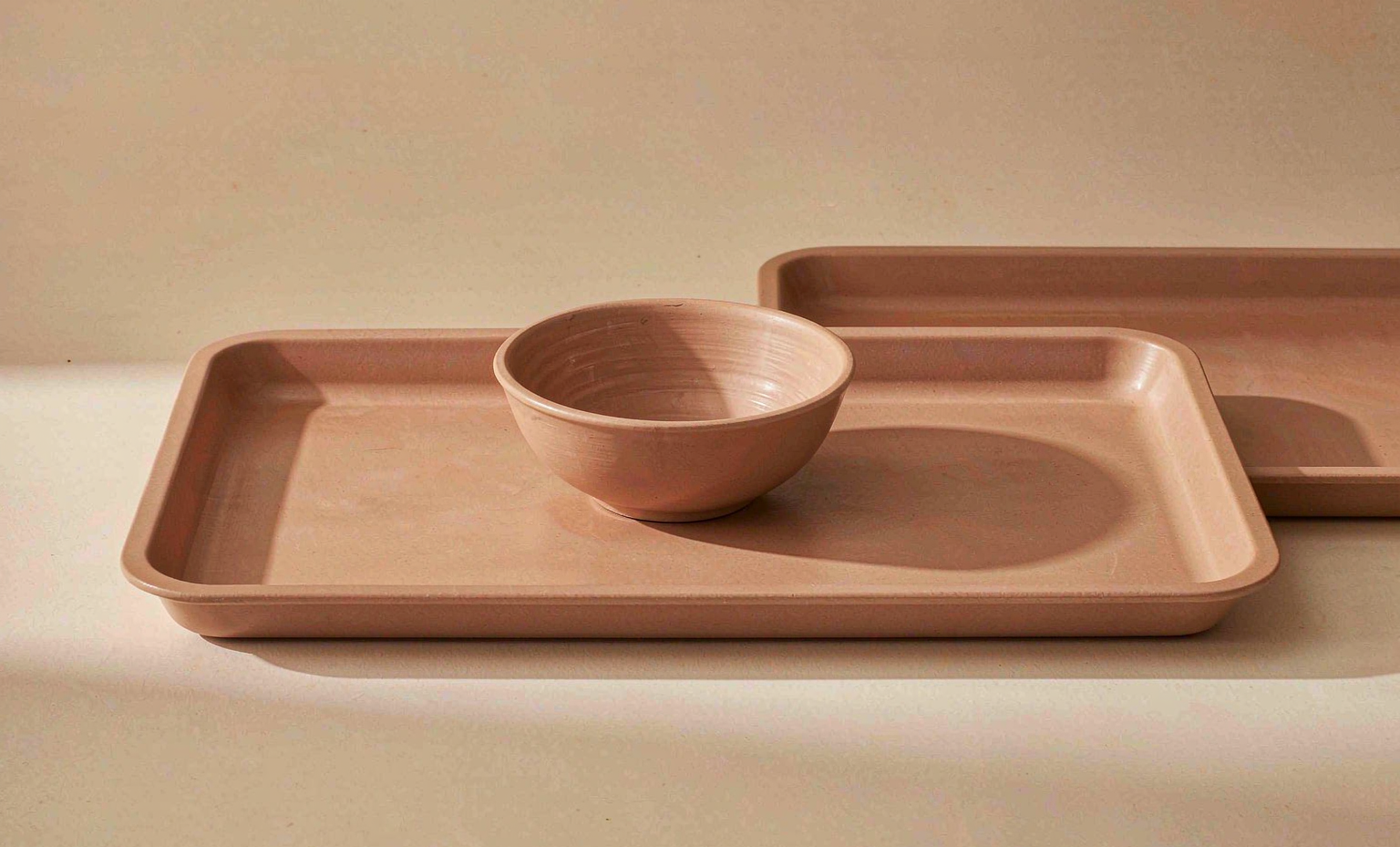
A new tableware program often starts with a dinner plate. For a chain restaurant, it should start with a serving tray. Serving trays for chain restaurants absorb more daily abuse than plates: wet handling, heavy loads, rapid busing, and repeated dishwashing. They are also the lowest-MOQ item in a tableware range. In our program, tray MOQ is 200 pieces; plates and bowls typically start at 300–500. That makes the tray a practical first order: small enough to limit exposure, demanding enough to reveal how a supplier molds, finishes, and delivers.
Why Start with a Serving Tray
Three factors make trays a better first order than a main plate.
Lower commitment. A 200-piece tray order sits below the 300–500-piece minimum common for plates and bowls. The absolute order value is modest, so a failed test is contained.
Clearer signals. A standard tray usually comes from one injection or compression molding cycle. Mold alignment, color control, material quality, and finishing discipline show up in the first carton. Complex glaze or decoration can hide those weaknesses.
Faster learning. Production lead time is confirmed case by case with your quotation. That is short enough to test the supplier's schedule before you commit the core tableware order.
The goal is not trays forever. It is evidence for the next order: plates, bowls, and the full table setting.
Match the Tray to the Job
Tray specifications should begin with the service task, not the catalog photo. The three roles place different demands on the same footprint.
Use case | What it must do | Specification priorities |
|---|---|---|
Service / busing tray | Carry meals and collect dirty ware | Textured non-slip surface, rigid body, easy-grip rim, raised edge |
Buffet / cafeteria tray | Hold several dishes during self-service | Broad flat area, low spill rim, stable stacking, rack fit |
Display / sharing platter | Present a shared dish at the table | Matte finish, large flat center, visual rim, scratch resistance |
For hand-carried service trays, most programs fall between 35 and 46 cm long. Check plate footprint and loaded balance; an overly wide tray is harder to control through a busy room. Buffet trays commonly run 38–53 cm, with a shallow rim that contains spills without blocking stacks. Display platters are larger, often 40–60 cm, and judged on how food reads from a seated guest. A deep busing tray makes a poor buffet surface.
Dimensions, Wall Thickness, and Rib Design
Three dimensions matter: outer footprint, usable flat area, and stack height. A wide decorative rim can leave less usable space than a smaller tray with a narrow rim. Measure all three against your plates, dishwasher rack, and storage cabinet.
Load capacity is not a single catalog number. It depends on span, rib layout, corner radius, material, and load distribution. Thicker walls add stiffness, but returns diminish; a deeper, well-placed rib can do more than a small increase in overall thickness. Ask for the test condition behind any load claim, then repeat the test with your own service load.
Check wall thickness at the center, rim, and corners; a thick rim can hide a thin center. Ribs should be open-ended, generously radiused, and free of narrow dead-end channels. Sharp closed ribs stiffen the tray but trap food and dishwashing residue. On a daily-use tray, that cleaning detail matters as much as stiffness.
Choose the Material for the Operating Model
Melamine is the default for most chain tray programs because it balances weight, impact resistance, and cost. Stainless steel and wood serve narrower roles; porcelain is presentation-only.
Criterion | Melamine (A5) | Stainless steel | Wood / bamboo | Porcelain / ceramic |
|---|---|---|---|---|
Weight | Light–moderate | Moderate–heavy | Light–moderate | Heavy |
Load capacity and durability | Rigid, impact-resistant; can warp with uneven heat | Strong; dents and bends at edges | Cracks or warps with heavy washing | Chip-prone at edges; not for busing |
Heat retention | Low–moderate | Low; conducts heat | Low | Moderate–high thermal mass |
Cleaning | Dishwasher-safe top rack; no microwave | Easy but scratches; noisy | Hand wash and oil; not for dish rooms | Easy glazed surface; heavy |
Look | Matte or gloss; broad color range | Industrial and bright | Warm and natural | Premium |
Relative cost | Low–moderate | Moderate–high | Moderate | High |
Wet-hand slip risk | Moderate; texture helps | High when polished | Moderate–high when oily | Moderate–high |
A5-grade melamine is commonly rated from -20°C to 120°C. That is a material tolerance, not a promise that a hot, tightly stacked tray will stay flat. Standard melamine is not microwave-safe. See our melamine dinnerware for options; if you need a ceramic look, reinforced porcelain adds weight and handling care.
Five Failures That Show Up in Real Chains
Most tray problems appear after the first week of service, not in the sample room.
1. Wet-hand slip. Gloss, washing residue, and a loaded plate are a bad combination. Surface texture helps, but deep grooves can trap oil. Test with wet, oily hands — not dry gloves — while carrying a realistic load.
2. Warping after dishwashing. A5 melamine tolerates -20°C to 120°C, yet a hot tray stacked tightly cools unevenly. Molded-in stress can release as a permanent bow. Rack correctly, avoid stacking while hot, and verify over repeated cycles.
3. Nesting lock. Trays wedge because of stack taper, warp, sticky residue, or vacuum. Stack lugs control nesting depth. Test separation after washing, while trays are wet and warm.
4. Corner damage. The four corners take the hardest impacts. A thin corner or tight radius concentrates stress and starts cracks. Check corner thickness and radius, then drop-test each corner.
5. Rack mismatch. A tray can match its listed size and still miss your dishwasher rack. Measure the usable opening and diagonal clearance, not just outer length.
What a 200-Piece Order Reveals About a Supplier
A tray is simple enough to expose fundamentals. It is not a full audit, but it supplies evidence a sample plate cannot.
Inspect 20 pieces across the run for dimensional consistency, rim straightness, and stack height. A sound mold holds those dimensions; a worn tool produces trays that rock, lean, or wedge.
Compare color under daylight from beginning, middle, and end of the run. Seven standard colors are available; Pantone matching starts at 1,000 pieces. Use physical color plaques, not screens, and agree the acceptance range before production.
Flow lines, dark specks, weak corners, and inconsistent gloss can indicate contamination or excessive regrind. Those faults matter most at thin corners.
Watch the schedule. The agreed lead time is a promise you can test immediately. If the first trays arrive on time and match the approved sample, you have a baseline for larger plate and bowl orders. Trendz coordinates partner factories and our supply network from Quanzhou so the tray run can set the standard for the wider program.
The Five-Test Tray Acceptance Checklist
Test production samples, not presentation samples. Keep measurements and photos for each batch.
Test | Method | Reject if |
|---|---|---|
Load and lift | Load to the heaviest realistic busing weight; lift by one long edge for 10 seconds; repeat 20 times | Visible bow or permanent set |
Wet grip | Wet hands with water and cooking oil; carry the loaded tray at a normal service angle | Slipping or loss of control |
Dishwasher cycling | Run 50 cycles on your normal program; measure flatness before and after | Warp, delamination, or color change |
Stack and release | Stack 10 washed trays; leave for 30 minutes; separate by hand | Tools or two people needed |
Corner drop | Drop each corner from counter height onto a hard floor; inspect | Chip, crack, or exposed core |
Passing these tests does not certify a tray for every kitchen. It shows whether the supplier controls a simple molded product under your real conditions.
FAQ: Serving Trays for Chain Restaurants
What is the MOQ for custom serving trays?
Tray MOQ is 200 pieces. Seven standard colors are available within that minimum; Pantone matching starts at 1,000 pieces. This makes trays easier to test than plates or bowls at 300–500 pieces.
Are melamine serving trays dishwasher safe?
A5-grade melamine is typically dishwasher-safe on the top rack and rated from -20°C to 120°C. That rating does not prevent warping when hot trays are stacked tightly. Run a 50-cycle test in your own dish room.
Which tray size works for buffet service?
Start with rack size, storage space, and the number of dishes. Most buffet trays are 38–53 cm long, but usable flat area and stack height matter more than nominal size. Test a loaded tray in the actual line.
How long does a tray order take?
Production lead time is confirmed case by case after approval of specification, color, and deposit. Payment terms are agreed per order. Confirm sample and shipping timing separately; both depend on the selected mold and order details.
Test a supplier with a 200-piece tray order before committing to the full program. Send your tray dimensions, typical load, rack size, finish, and target color through our contact page. We coordinate partner factories and our supply network from Quanzhou, with seven standard colors and an agreed production window, and confirm the specification before quoting.

