
Oct 27, 2026Chain Operations
Kitchen Shears and Utility Scissors: One Platform, Four Trade Families
Kitchen, tailor, household and grooming scissors share one blade-and-pivot platform. What changes between families, and the 0.03-0.12 mm pivot tolerance that decides cutting quality.
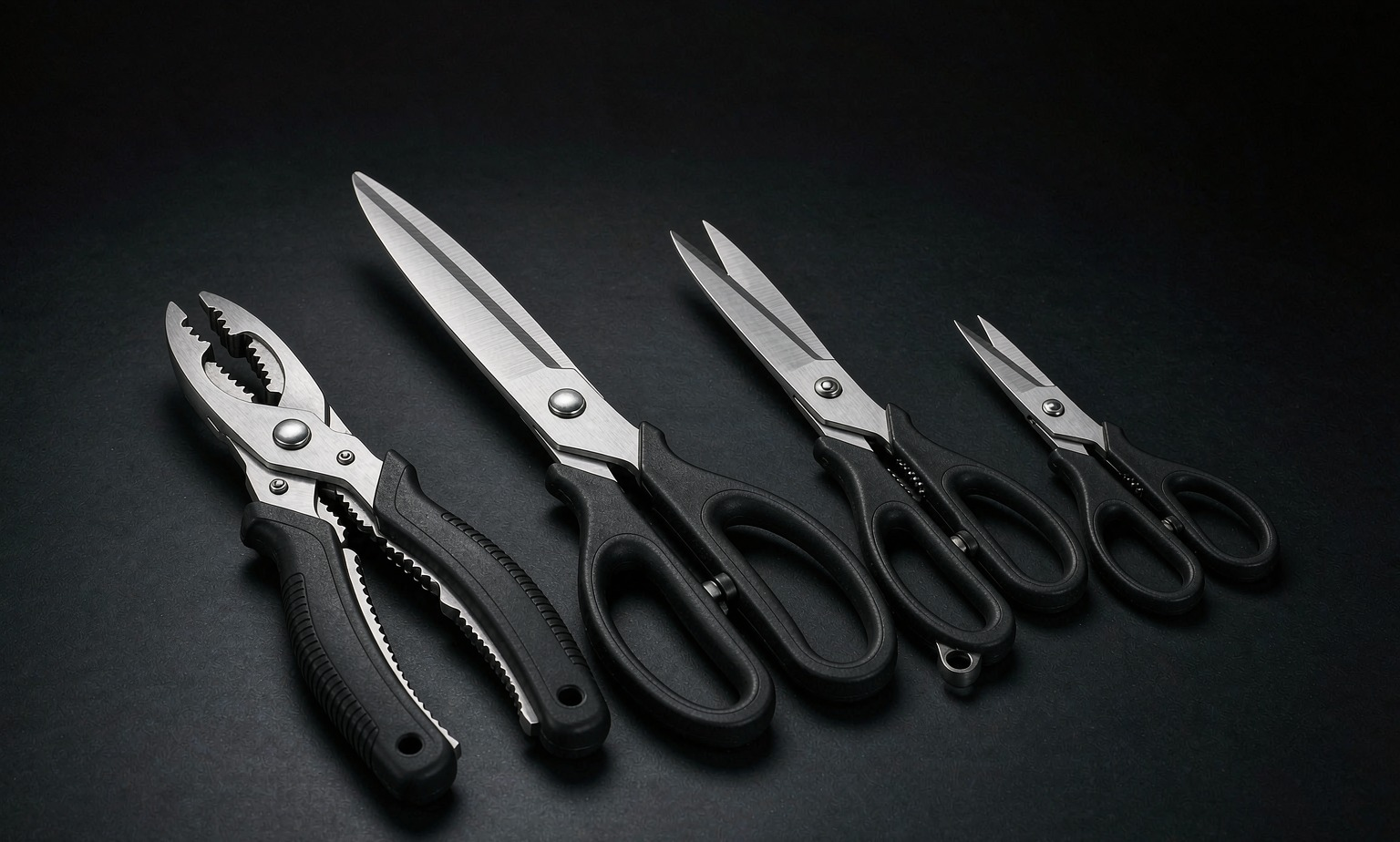
Kitchen Shears and Utility Scissors: One Platform, Four Trade Families
Scissors look like the simplest item in a hardware program: two blades, one pivot, two handles. That simplicity is exactly why sourcing them is deceptive. The same blade-and-pivot platform produces kitchen shears that strip a chicken, tailor shears that cut silk without slipping, and grooming scissors that trim a nail curve — and the differences that matter are invisible in a product photo. They live in pivot tolerance, blade geometry, steel grade, and finishing.
This guide walks through the four trade families built on one manufacturing platform, what changes between them, and the acceptance metrics a chain buyer should demand.
Why the Platform Matters to Buyers
A factory that builds kitchen, tailor, household, and grooming scissors on one shared platform inherits tooling discipline across all four lines. Pivot press tolerance, grinding consistency, and heat-treatment control transfer between families. A factory that makes each family as a one-off product reinvents those variables every time.
For procurement, the platform question is a risk question: ask a supplier how many scissor families they run on shared tooling. The answer predicts how well they will hold the specification across a large order — and how quickly they can extend the line next season.
The Four Families and What Each Must Do
Family | Steel and hardness | Key geometry | Built-in functions | Typical duty |
|---|---|---|---|---|
Kitchen shears | 3Cr14, 52–54 HRC | Broad blades; separable halves | Take-apart pivot, nutcracker, bottle opener | Poultry, herbs, packaging, fish |
Tailor and fabric shears | 5Cr15MoV, 54–56 HRC | 9–11 in; offset handles; micro-serrated edge | None — cutting purity | Heavy cloth, leather, multi-layer fabric |
Household multi-purpose | 420J2, 52–54 HRC | 6–8 in; straight blades | General purpose | Paper, card, light packaging |
Manicure and grooming | 420J2, 52–54 HRC | Fine-tipped precision jaws; curved or straight | File surfaces on some models | Nails, cuticles, fine grooming |
Kitchen shears earn their place by force functions: the take-apart pivot lets the halves separate for hygiene-critical cleaning after raw poultry, and the nutcracker and bottle opener built into the handle keep the tool on the magnetic rail instead of the drawer.
Tailor shears are the precision instrument of the family. The offset handle keeps fingers above the fabric plane, and the micro-serrated edge grips slippery material — the difference between a clean 4-meter cut and a slipped, drifted one. At 9–11 inches with 54–56 HRC steel, this is the family that punishes a soft blade fastest.
Grooming scissors are the finishing test of a factory: mirror polish, fine-tipped jaws, and curve options demand hand-finishing that volume lines never develop. A factory that holds 0.05 mm tolerance on grooming jaws can hold anything.
The Number That Decides Cutting Quality: Pivot Tolerance
Blade steel gets the marketing; the pivot gets the returns. Scissor cutting quality lives and dies on the blade gap — the distance between the two blades from pivot to tip under cutting load.
Our platform specifies 0.03–0.12 mm blade gap, verified on the tailor line at 100% inspection and by AQL 1.0 sampling on household and grooming lines. The window is narrow for a reason:
Below 0.03 mm: the blades bind, especially after washing or in humidity. Handles feel gritty; the user forces the cut.
Above 0.12 mm: material folds or slips between the blades instead of cutting. Tailor shears stop gripping cloth; kitchen shears smear chicken skin.
The gap is set by the pivot screw's bearing surfaces and held by the blade's flatness after grinding. It is checked with feeler gauges at the pivot, mid-blade, and tip — three points, because a blade that is straight at the pivot can still bow at the tip.
Steel and Hardness by Family
Scissors need less hardness than knives: they shear rather than chop, and the cutting load is lateral. That is why 52–56 HRC covers the whole range:
420J2 at 52–54 HRC carries household and grooming lines. Adequate edge life for paper and nails, excellent polish, lowest cost.
3Cr14 at 52–54 HRC gives kitchen shears slightly better corrosion behavior against food acids and salt — relevant for a tool that lives near the sink and comes apart for washing.
5Cr15MoV at 54–56 HRC serves tailor shears, where multi-layer fabric and long cutting strokes reward the finer carbide structure. Harder steel holds the micro-serration profile longer.
Handles are where the families diverge visually: kitchen shears carry larger grip handles with function cutouts; tailor handles offset; grooming handles shrink to finger loops. Handle material follows duty — PP or TPR over steel for kitchen and household, polished steel or coated scales for grooming.
Acceptance Metrics a Chain Buyer Should Demand
Scissors fail in predictable, measurable ways. Write these into the specification:
Metric | Target | Method |
|---|---|---|
Blade gap | 0.03–0.12 mm | Feeler gauge at pivot, mid, tip |
Cutting function | Clean cut through designated test material, full blade length | Cut test per family: cloth for tailor, chicken bone for kitchen shears |
Pivot screw torque | Defined torque window; no loosening after 500 cycles | Torque driver + cycle test |
Separation force (kitchen) | Halves separate by hand without tools; reassemble tight | Assemble-disassemble test after washing |
Surface finish | Per family: mirror for grooming, satin for utility | Visual against approved sample |
Corrosion | No rust after salt-spray or 48h humidity exposure | Salt spray / humidity cabinet |
The 500-cycle pivot test matters more than it looks: a pivot that loosens in service turns a good scissor into a complaint generator, and it is the failure most often missed by visual inspection.
Market Notes: What Each Region Orders
Japan and Korea order grooming and kitchen scissors at high finishing levels — mirror polish, gift packaging, tight jaw curves. Tailoring demand concentrates where fabric markets are strong. Household multi-purpose scissors are the volume backbone everywhere, but pack count and price point decide the order, not specification.
Mexico's craft and fabric retail channel orders tailor shears at 10–11 inches with heavier handles. Across markets, the specification that survives is the same: tight pivot tolerance, family-correct steel, and finishes matched to price tier.
Frequently Asked Questions
Why do kitchen shears need to come apart?
Hygiene. Food residue collects at the pivot between the blades, and a fixed pivot cannot be cleaned properly after raw poultry. A take-apart pivot is the baseline specification for commercial kitchen shears.
What does micro-serration do on tailor shears?
The serrations grip the fabric so it does not slip forward as the blades close. The trade-off is a slightly less clean edge on very fine material, which is why heavy-cloth shears carry serration and silk shears do not.
Is 420J2 good enough for scissors?
For household, grooming, and light utility — yes, comfortably. The lateral cutting load of scissors is gentler on an edge than chopping. Tailor shears deserve 5Cr15MoV for edge life under fabric load.
What should I test on samples before ordering?
Blade gap at three points, full-length cut test on your actual material, pivot torque before and after 500 cycles, take-apart function after washing, and finish against the approved sample. Record results per family.
Specifying scissors for retail or food-service programs? Send your family mix, target price tier, and packaging needs through our contact page. Our partner factories run shared scissor platforms with 100% gap inspection on the tailor line and AQL 1.0 sampling elsewhere.

