
Oct 27, 2026Chain Operations
Kids' Tableware for Family Restaurant Chains: Safety, Design, and the Guest-Parent Relationship
The kids' set is the most scrutinized object on the table. Material selection, edge and grip design, drop survival, and the documentation parents never see but regulators do.
Kids' Tableware for Family Restaurant Chains: Safety, Design, and the Guest-Parent Relationship
A family chain's kids' set is its most closely inspected tableware — not by the QA team, but by a parent holding it up under the dining room lights while deciding whether to come back. That scrutiny shapes every good kids' program: materials that survive both the dishwasher and the drop test, edges that forgive toddler grip, and documentation that would satisfy the most skeptical adult at the table.
This guide covers the design and sourcing decisions behind kids' tableware programs that work at chain scale.
Materials: The Shortlist
Kids' tableware materials are a short list, and the reasons are practical:
Melamine and similar thermosets. The workhorse: nearly unbreakable in service, dishwasher-stable in commercial formulations, light enough for small hands, and moldable into the rounded, grippy shapes kids' programs need. The specification points are the formulation (commercial-dishwasher-rated, not retail-only) and per-SKU food-contact documentation, since kids' items attract regulatory attention out of proportion to their cost.
Polypropylene and similar thermoplastics. Lighter, cheaper, and more drop-forgiving still; the trade-offs are scratch visibility, staining with strongly colored foods, and a shorter visual service life. They suit high-rotation family concepts where the set is replaced on schedule anyway.
Silicone components. Used for gripped bases, suction elements and bib-style accessories. Food-grade silicone is soft, quiet, and heat-tolerant; the specification points are grade and attachment design — a suction base that detaches mid-meal is a return-driver, not a feature.
What stays off the list. Glass and ceramic in kids' sets are excluded by drop liability regardless of concept tier. Bamboo-fiber composites marketed heavily in retail carry formulation questions that make documentation review essential before any program adopts them.
Design Details That Decide the Guest Experience
Kids' tableware design lives or dies on details adults never notice until they are wrong:
Edges and radii. Every edge a small mouth can reach should be generous-radius and smooth. This is both a comfort and a safety posture, and it is checkable at sampling by running a finger around every rim.
Grip geometry. Sections sized for small hands, with textured or contoured grip zones on cups and bowls. The test is empirical: if the sample survives a table drop onto tile from child height during the review, it is in range; if it does not, no specification sheet saves it.
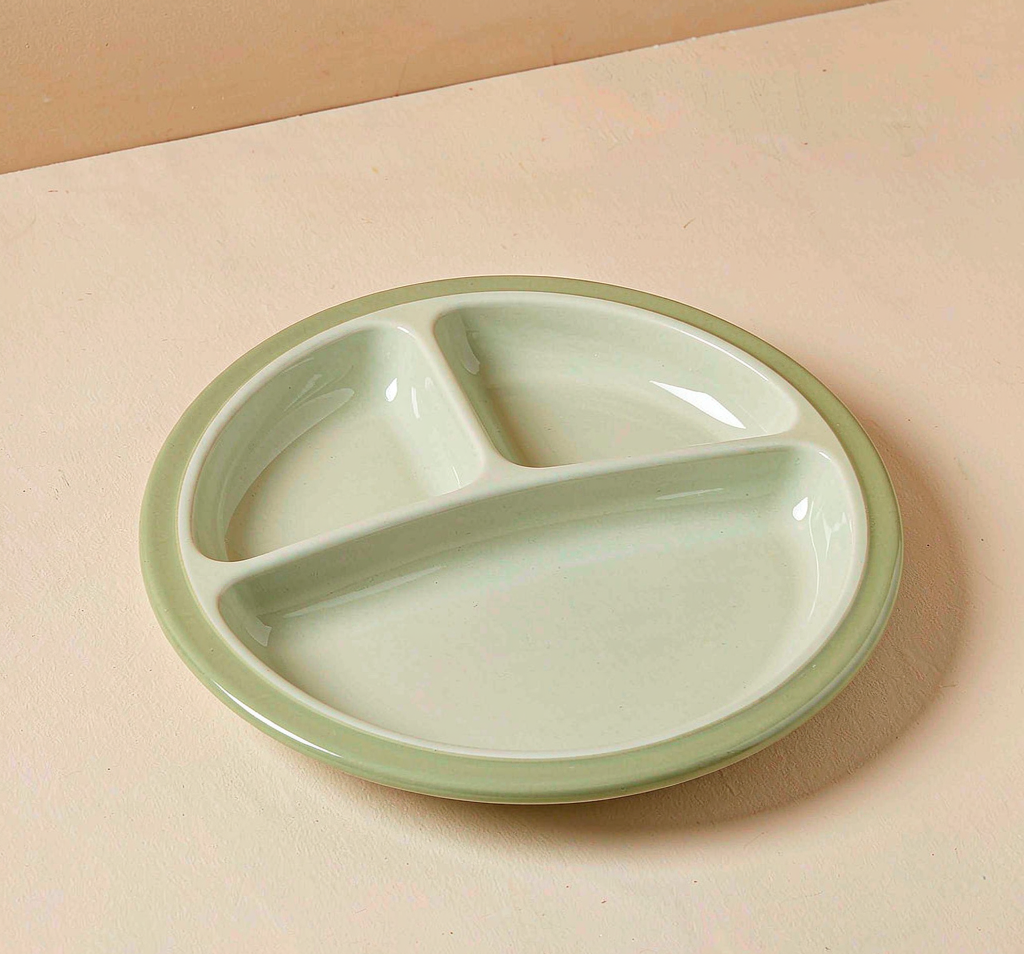
Portion-logic shapes. Divided plates that map to actual kids' menus (one section each for main, sides, fruit) reduce food-to-food contact complaints and photograph well in menu marketing. The divisions must be deep enough to survive saucy dishes or the feature becomes a claim.
Color permanence. Kids' sets live in a dish room with dyed foods and harsh cycles. Colorants that fade within a quarter make the set look older than the store; batch color standards are as important here as in the adult program — arguably more, because parents notice the mismatch between the photographed menu and the faded table.
The Documentation Layer Parents Never See
Kids' food-contact items are the most document-sensitive SKUs in any tableware program. The working standard for chains:
Per-SKU food-contact test reports from recognized laboratories for the materials and conditions of use — the report package should name the actual items, not a category.
Batch traceability so any single set can be traced to its production lot — the same discipline as the adult program, with higher stakes.
Formulation disclosure on request for the plastics and coatings in the set, so the chain's compliance team can answer regulator and parent questions without a scramble.
None of this is visible in the dining room; all of it becomes visible the first time a question is asked publicly. Programs built with the file complete from day one simply absorb such moments.
Operational Notes at Chain Scale
Rotation on schedule. Kids' sets are consumables in practice: scratches, fades and general wear arrive faster than on adult programs. Chains that schedule replacement keep the "looks like the photo" standard without waiting for complaints.
The take-home question. Many family concepts sell or give the kids' set as merchandise — which changes the specification from service-wear to retail-grade packaging, barcoding, and often retail compliance labeling. Decide the program's answer before sampling, because the packaging line is a different project.
Stocking depth. Kids' sets vanish (take-home souvenirs, breakage, and misplacement at higher rates than adult items). Buffer depth follows measured loss, same discipline as the breakage program, with a shorter review cycle.
Frequently Asked Questions
Is melamine appropriate for kids' items? Commercial-grade melamine with per-SKU food-contact documentation is standard in kids' dining sets; the key is the documentation and the dishwasher-rated formulation, not the material name.
How do we test drop survival honestly? Drop samples onto tile from realistic heights during the review, repeatedly, and inspect for chips and cracks. A set that needs careful handling fails the concept.
What fades kids' set colors fastest? High-heat cycles with aggressive detergents and strongly dyed foods. Both are controllable; both should be part of the wash specification the supplier signs.
Should kids' sets match the adult program's design language? Roughly, yes — the kids' set is brand merchandising. The materials and geometry differ; the color standard and logo treatment should not.
What triggers the most parent complaints? Worn appearance (fades, deep scratches) far ahead of functional failure. Scheduled rotation answers it before it becomes a review.

