
Oct 27, 2026Chain Operations
Forged vs Stamped Kitchen Knives: Weight, Edge Retention, and Cost in Chain Kitchens
Forged is not automatically better. Where forging earns its price, where stamped blades serve better, and the four sample checks that settle the debate for your kitchen.
Forged vs Stamped Knives: Weight, Edge Retention, and Chain-Kitchen Cost
The forged vs stamped kitchen knives debate usually starts with a simple assumption: forged is professional, stamped is cheap. That assumption leads chains to overspend on the wrong blade or dismiss a tool that would serve a central kitchen better. The real differences are weight, balance, handle construction, and how the knife is maintained over years of shifts. Steel grade and heat treatment often matter more than the forming process. This guide separates the manufacturing facts from the sales language, then shows how to choose by station and verify samples before a multi-country rollout.
Forged vs Stamped: The Manufacturing Difference
Forging starts with a heated steel billet shaped under pressure, which produces a denser grain structure and allows a thicker bolster and a full tang. The blade is then ground, heat-treated, and finished. A forged knife typically carries a full bolster at the heel and riveted scales over a full tang.
Stamping starts with a flat steel sheet: the profile is cut out, then heat-treated, ground, and edged. Stamped knives are usually lighter and thinner, often with a molded handle or a partial tang. Neither process guarantees a good knife. A forged blade with poor heat treatment will not hold an edge, and a well-made stamped blade can outperform a careless forging.
Attribute | Forged | Stamped |
|---|---|---|
Starting material | Heated steel billet | Flat steel sheet |
Blade thickness | Thicker spine, distal taper | Thinner, lighter |
Bolster | Usually full bolster | Often none or small |
Handle | Full tang, riveted scales | Molded or partial tang |
Weight, 8-inch chef | Roughly 220–260 g | Roughly 140–180 g |
Unit cost drivers | More material, grinding, finishing | Less material, faster finishing |
Typical fit | Heavy prep, protein work, premium service | Vegetable prep, central kitchens, high-turnover teams |
The Performance Myth: Forged Is Not Automatically Better
The useful question is not forged or stamped; it is whether the knife's geometry and steel match the task. Forging gives a heavier blade with a solid bolster, which can improve balance and reduce vibration in heavy chopping. It also gives a stronger handle junction, which matters when a knife is used hard.
Stamping gives a thinner blade that glides through dense vegetables and reduces wrist effort. It is also easier to clean and replace. A stamped knife with good steel and a thin, consistent edge can be the better tool for a vegetable station. A forged knife with a thick edge can feel like a wedge in the same job. Judge the edge, not the label.
Weight and Fatigue Across an Eight-Hour Shift
An eight-hour shift turns weight into a real cost. A typical forged 8-inch chef's knife often weighs roughly 220–260 g, while a stamped 8-inch knife often lands around 140–180 g. Treat those as sample-dependent benchmarks, not catalog guarantees. The gap is about the weight of a large smartphone, held at the end of a wrist, thousands of times per shift.
That does not automatically make the stamped knife better. A balanced forged knife can feel lighter in use than its scale weight suggests, because the bolster moves the center of gravity toward the hand. A tail-heavy stamped knife can feel heavier than its number. Weigh the sample, then test it through a full prep task. Fatigue shows up in the last hour, not the first.
Edge Retention Depends on Steel and Heat Treatment
Edge retention is mostly a function of steel chemistry, hardness, edge geometry, and heat treatment. It is not a function of forging versus stamping. A forged knife made from soft steel will roll or dull faster than a stamped knife made from a harder, well-treated steel.
Our Forged Chef Series uses X50CrMoV15 at 56–58 HRC; the santoku and utility profiles use 5Cr15MoV. Those are different starting points for different tasks, not a ranking of processes. Our supply network also works with 420J2 for applications where corrosion resistance and ease of maintenance matter more than edge holding. What matters in procurement is consistency: the same hardness range from piece to piece, a clean edge apex, and a grind that does not overheat the steel. Ask for hardness verification and edge geometry checks, not just a process label.
The Bolster Trade-Off: Balance Today, Grinding Problems Later
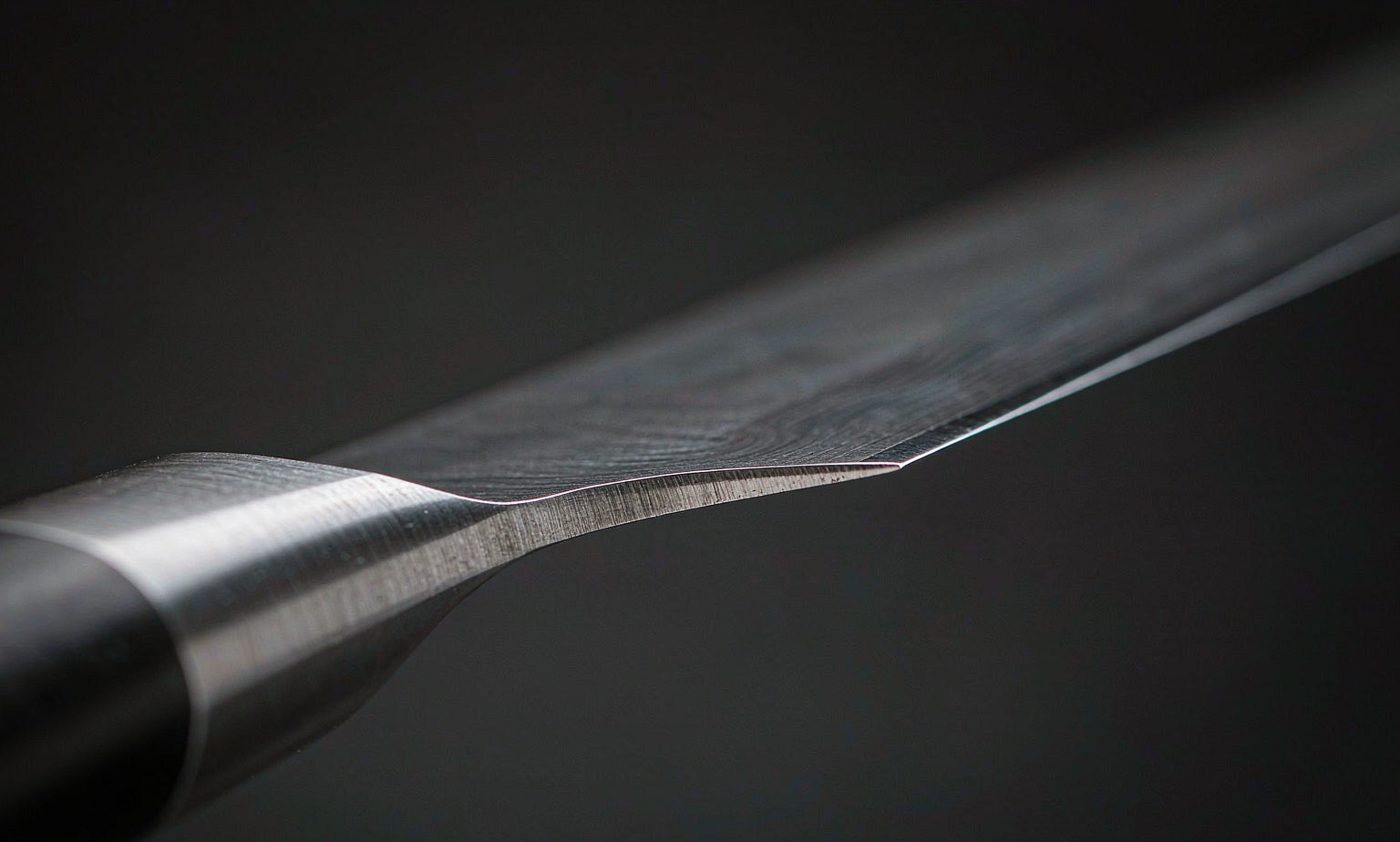
A full bolster is a trade-off. It adds weight at the heel, protects the fingers from slipping forward, and stiffens the transition between blade and handle. It also blocks the heel from reaching a whetstone.
Over months of sharpening, the unsharpened heel can remain thick while the rest of the edge recedes, creating a small hook at the back of the blade. The knife still cuts, but the heel stops engaging product, and the cook applies more pressure. Some kitchens accept this because the bolster improves control. Others prefer a relieved bolster or no bolster so the full edge can be maintained. The right answer depends on who sharpens the knives and how often.
Cost Structure, Kitchen Fit, and Sample Verification
Cost comparisons should include the full life of the knife. Forged knives carry more material and finishing steps, so their unit cost is higher. Stamped knives cost less to produce, but a thin blade may need replacement sooner in heavy use, and molded handles can fail at the tang. Forged knives may need professional grinding to correct the heel over time. The cheapest knife per unit is not always the cheapest per shift.
Use the kitchen type to set the default:
Vegetable-heavy chain: stamped or thin forged blades reduce wrist fatigue and cost per station.
Central kitchen with heavy chopping and protein portioning: forged 8–10 inch chef's knives with full tang and riveted handles hold up to hard use.
Premium dine-in: forged knives with balanced bolsters and consistent finish support the brand experience and feel substantial in the hand.
High-turnover operation with limited sharpening skill: lighter blades with easy-to-maintain edges are the pragmatic choice.
Before approving a sample, verify four things: spine thickness consistency along the blade, heat-treatment uniformity, the bolster-to-edge transition, and handle rivet security.
Check | What to inspect | Why it matters |
|---|---|---|
Spine thickness | Caliper at heel, middle, and tip | Inconsistent grind changes balance and cutting feel |
Heat treatment | Hardness test across a batch | Soft spots dull early and are invisible in photos |
Bolster transition | Visual and finger check at the heel | Gaps trap food and weaken the edge junction |
Rivet security | Twist and pull test on the handle | Loose scales are a safety issue in daily use |
A supplier running 100% visual and function checks at shipment, AQL 1.0, and in-process hardness checks every two hours gives you a traceable baseline. Our partner network reports 98.6% first-pass yield and 120,000 pieces per month, which matters when a multi-country rollout has a fixed opening date. None of these checks replace cutting trials with your own products. For planning, our partner factories quote on day 0, deliver pre-production samples on day 7, and run first mass production on day 35–45 after tooling approval.
FAQ: Forged vs Stamped Questions from Chain Buyers
Is forged always better than stamped?
No. Forging offers a heavier blade, a full bolster, and a strong handle junction, but a poorly heat-treated forged knife can underperform a well-made stamped knife. Match the construction to the station, the menu, and the people who will use it.
Do forged knives stay sharp longer?
Not automatically. Edge retention depends on steel chemistry, hardness, edge geometry, and heat treatment. A forged knife in soft steel can dull faster than a stamped knife in a harder, well-treated steel. Ask for hardness and geometry data, not a process claim.
Which type is better for a chain kitchen?
Most chains do best with a mixed standard. Use lighter stamped or thin forged blades for vegetable-heavy stations, and forged full-tang knives for heavy chopping and protein work. Standardize handles and steel families, then test both options on the line.
How can I check quality before ordering?
Inspect spine thickness at the heel, middle, and tip; verify hardness across a batch; check the bolster-to-edge transition; and test rivet security. Confirm the supplier's inspection plan, AQL level, in-process checks, and capacity before committing to a rollout.
Reviewing a knife specification for a multi-country rollout? Send your menu, station plan, and volume forecast through our contact page. Our team will recommend forged, stamped, or mixed configurations from our partner factories, arrange samples, and map a production schedule that fits your opening date.

